Showing posts with label transformation. Show all posts

13 January 2019

There Are So Many Things We Can Be Doing!

I think I'm just going to make a list today. I haven't offered this sort of thing in a long time, but we attended a meeting the other night where lots of ideas for what a nearby city (and the capital city of my province in Canada) can do about the climate crisis. I'll add in some of my own ideas.

Change now, as philosopher Krishnamurti taught. Picture … dream … envision how the world needs to be: free of war, terrorism, violence, cruelty and slaughter. A world free of fossil fuels, a “golden age” of zero-carbon renewable energy, will be safer, cleaner, kinder, healthier, more equitable, and more peaceful. It’s a beautiful vision, isn’t it?

For the sake of the children – of all species – find the strength, the courage and the compassion to truly feel the pain of the climate crisis. Next, lament. And then, get active. Remember that the most vulnerable are being impacted worst and first, but we are all impacted. People around the world are losing their lives or their loved ones, their livelihoods, their food security and water sources, their homes and entire homelands, in extreme weather events caused or exacerbated by climate chaos. We also need to understand this from the perspective of indigenous people, who have nowhere to move to because they are their land.

If you and your family are not already eating a plant-based diet, go vegan now, for the sake of your own health and the health of the planet. It’s the quickest – and most significant – way to lower your greenhouse gas emissions. Further, how can we create peaceful transformation in a world filled with slaughter and cruelty?

The Burning Age is over. Support a carbon fee and any other strategy that will encourage people to switch their investment money to zero-carbon, non-combustion renewable energy. Work towards a combustion-free society by transitioning away from the internal combustion engine.

Call for your government to keep its pledge to end taxpayer subsidies to fossil fuel industries. According to the International Monetary Fund, every year governments around the world give $5.3 trillion in direct and indirect subsidies to fossil fuel corporations. Just think how much faster we’ll make the transition to zero-carbon, non-combustion energy when all that money is switched to renewables.

Make a plan for reducing your family’s carbon footprint as rapidly as possible. Invest in the future by ensuring that your investments are ethical and green. Divest from fossil fuels. Vote with your dollars. Invest in a heat pump for your home to lower your heating bill. If you need to drive, save up to purchase a hybrid or electric vehicle. Figure how far you and your family are willing to walk, bicycle, take public transit, car share, etc., and set up systems to help you use these greener modes of transportation more often. Be willing to make changes, compromises, even sacrifices for the sake of the future.

Support fair elections and electoral reform so that governments are made up of elected officials representing all voices, not just those beholden to fossil fuel industries.

Learn the basic science of the unprecedented crime of greenhouse gas pollution and the anthropogenic (human-caused) climate and oceans crisis it has led to. Then learn why climate disruption and the trifecta of ocean heating, ocean acidification, and ocean de-oxygenation represent an urgent emergency. Understand that the climate change denial campaign is deliberate and extremely well funded. They can sound convincing, but don’t be fooled. Do your own research, check your sources, and stay strong.

The greatest immediate threat is food and water insecurity. After all, we have evolved over the last 10,000 years into a species dependent on agriculture – and agriculture is dependent upon a stable climate, which we’ve had globally for the last 10,000 years – until now. Encourage ecological and regenerative agricultural practices and the implementation of permaculture principles. Mulch your garden. Plant trees. Lend support (time, money, energy, expertise) to food-growing programs for children and schools. We can’t grow food overnight; nor can we learn to grow food overnight. Be a champion for a different kind of education … one that will help create the world we need.

Permaculture the heck out of your community. Turn public spaces and boulevards into food forests. Build food security, food sovereignty, food resilience. (If climate chaos is going to lead to worldwide hunger, at least we'll be among the last to go.)

Get your local municipal government/s to declare a climate change emergency. (The Climate Mobilization can offer guidance with this.)

Protest outside of any bank that is investing in global destruction. Divest while you're at it, and put your money into a community bank or credit union.

Pull off some "intersactions." Take your protest signs to the busiest intersection in your community and keep crossing the road when the walk sign is on walking around in a square. Get it? High visibility. Not illegal. Drivers won't be turned off because you're not blocking traffic.

Remember to make your planning meetings and your public actions inclusive (invite others who might not normally participate) and accessible (for example, to people with disabilities, to parents with small children). 

Finally, do your spiritual work – pray, meditate, dance, go for walks, whatever – but don’t stop there! Remember, we all have at least a little bit of time, money, energy and/or expertise to share.

 And hey, if none of these actions feels right to you, you can always bake muffins for those on the front lines of saving the world. Even protestors have to eat!

Adapted from Henry Van Dyke


28 July 2013

Reform, Revolt, Transformation (and Vitamin B12)

A tweet wafted past me the other day (I don't go checkin' out Twitter ... no time) and it really stuck out as profound, and maybe important. Here's what I saw: 
AntiReform ProRevolt @Anti_Reform Reform is designed to create an illusion of progress.
That reminded me of a discussion my hubby and I had had recently in our kitchen. In a (possibly B12 deficiency-induced) moment of guilt (did you know that about vitamin B12?), I was talking about something I haven't successfully shifted in my life. "Well, at least I'm further along than most people." 

Now, in the interests of not misquoting my beloved, I can't tell you exactly how he responded because I can't remember exactly what he said (I've since upped my B12 intake!). But it wasn't a pretty observation about our culture and it led to the following realization for me. We've been posing the wrong question all these years. We've been asking
What can I do? 
instead of 
How must I change?
"How must I change?" shows an understanding that transformation is necessary. It shows a willingness to make necessary sacrifices. It shows an appreciation that we're all implicated (it's not someone or something else that must change). 

A couple of weeks ago, I told you that "What can I do?" usually means "I'm not really interested in doing anything (because if I was, I would have done it by now)." "How must I change?" sounds like a sincere quest ... a call for a personal revolution that will snowball (ahem, a lot of those melting these days, eh?) into societal transformation. 

Reform has taken us nowhere but backwards. Revolt? My gosh, that's a toughie. So many human beings are too comfortable. So many other human beings are struggling every day of their lives. Where are those who will risk revolt or who can afford revolt? 

I suppose that's why I talk of rapid transformation to a zero-carbon economy, one that will be safer, cleaner, healthier, more equitable and more peaceful. Because who, who, who would not want that?

Have you heard of the 12-second transition? A prof at university talked about it. I remember experiencing it myself one morning when I threw open my dorm room window after pulling an all-nighter to complete a paper. The beautiful spring air wafted in and the pheasants down in the ravine behind our college started squawking their morning greeting. Instantly, I transformed from an armchair-hugging bookworm to someone who delights in the natural world and outdoor pursuits. It was virtually instantaneous.

If we can fall in love at first sight, become parents overnight, have an accident that changes everything in an instant ... then we know that rapid transformation is possible. For the sake of the children and future generations of all species, how must we change?

14 April 2013

Why Scientists are NOT Saving the World

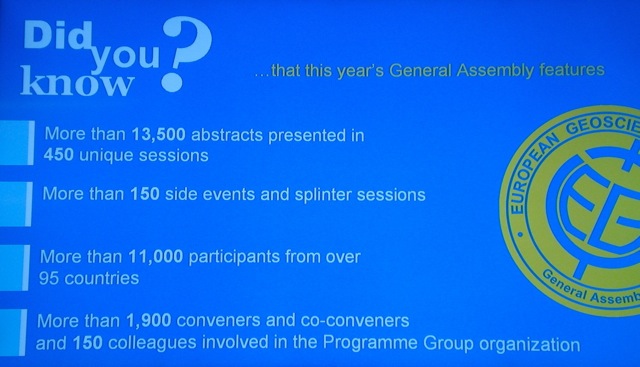
We (my husband and I) have spent the week at a huge geophysical science conference — thousands upon thousands of scientists who study the non-living aspects of the Earth converged in one place — and only one showed up for a special session to determine whether we have enough evidence to declare that we're in a state of climate change planetary emergency.

Why is that? In Tuesday's conference newsletter, the conference communications officer said, "The life of a scientist is not an easy one. In addition to pushing the boundaries of our knowledge, scientists have the added pressures of applying for grants, enhancing public understanding, teaching, publishing, data-crunching and generally saving the world as they multi-task to the extreme!"

I'm curious about what part of "generally saving the world" equals ignoring the emergency signs (or being unwilling to talk about them) when a bit of synthesis shows so clearly that they exist.

Is it because scientists believe that only governments, or the people they, ahem, represent, can use terms like "dangerous" and "emergency"? That's what the Intergovernmental Panel on Climate Change keeps insisting, saying that it's a value judgement.

In this case, is it because these are not life scientists? That doesn't automatically make them non-life (or worse, anti-life / life-as-nuisance) scientists, does it?

Is it because scientists aren't confident learning or talking about social issues (and they see the global transformation we have to make as primarily a human/social development issue?), the way non-scientists often aren't comfortable in scientific discussions?

Perhaps it's due to the reductionism that keeps constricting ever tighter the higher up the science education ladder you go. Take a look at your average elementary school science curriculum. It includes processes of science, life science, physical science, and Earth and space science. But once you're doing your PhD in "morphodynamics of particulate geophysical flow" or "Earth's inner magnetosphere coupling," you've left a lot of your biology — the study of life — behind.

Is it that we've placed too much confidence in our scientists — and too much responsibility upon them?

This whole thing helped me see that our salvation does not lie with scientists, who have to research, apply for grants, enhance public understanding, teach, publish, and crunch data before they'll ever get around to saving the world. I am no longer in awe. They are simply busy human beings, like the rest of us. 

Scientists do not have a monopoly on world saving, that's for sure. Not that I want to let them off the hook entirely, either. We're all in this together.

p.s. I want to apologize to anyone who has left a legitimate comment recently. I tried "deregulating" who can make a comment and how, but ended up with dozens of spam messages practically overnight. (Spammers, give just a fraction of that time to the climate change fight!) In trying to get rid of the spam, I got rid of several wonderful comments, too. I'm very, very sorry about that, as I have no way of retrieving them. (Ah, the tyranny of the "enter" key.)

22 January 2010

Where are we going, and why am I in a handbasket? — A Guest Post

I love that saying on a bumper sticker! A "virtual friend," Norma Lundberg, wrote the other day to say that her father used to use that expression ("We're all going to hell in a handbasket"), and would then add, "One of these days, people will get off their hind legs and then we'll see." (We're not off our hind legs yet, unfortunately.)

Today, I would like to hand over this space to my online friend, Norma, who is wise and artistic and eloquent: a Renaissance Woman, storyteller, quilter, polyglot, lover of the arts and culture and a mentor in considering how these traditions can help us do the right thing today for future generations — if we choose to.

Cassandra ... had the power to predict the future, and none of us has that. Climate change science people are getting very good at predicting trends derived from all the data accumulating, but you don't have to be a scientist to have lived long enough to note some significant changes over time that indicate sufficient deterioration leading to high risk of collapse. Just think: it was only in the past year that Toronto city council [in Ontario, Canada] decreed that it would now not be illegal to hang clothes to dry in one's backyard.

In fact, you don't have to be a futurologist at all to see, from our privileged and only partly informed position in the well-to-do northern countries, that the disaster has ALREADY struck, is already ongoing, in the poorer countries to the south after decades, centuries of ongoing pillaging, plundering, and rapacious greed from the north, demolishing cultures, social systems, natural resources, local governments and so much more, leaving in their wake drought, disease, famine, warfare, and dictatorships practising fear and torture. Too many years of treating the planet and all its creatures as disposable.

[...]

You wrote that "it's good to have resources for starting to learn what this new world could look like," [but people] don't listen to the music, look at the work by people making art engaged with the land and the weather, don't read poetry, don't read much of anything it seems, don't read philosophy, don't speak or read other languages, don't gather for coffee and actually TALK about politics....

[...]

Yes, call people stupid and incapable and feed them sanctioned pablum, don't for whatever god's sake be passionate, partisan, informed.... Listen to Shostakovich, read about his work, his times, the history, and see if you're not a little bit stirred by the music. It doesn't need subtitles. It just needs to be listened to, and poetry needs to be read, and art has to be looked at. It's all part of having eyes, ears, senses, and of finding out what we think of what we see, hear, sense. We don't have to be told what to like, but we do have to think, and experience, and wonder, and question. Isn't that what education is about? Isn't that what being part of the world means?
My appreciation, Norma. Anything earnest and honest is a joy to read these days (given the "pablum" we're mostly fed). I should point out that Norma's heartfelt "rant" was in response to my rant in response to an educational listserve's discussion of the role of education in transforming the world in order to safeguard the future for our students.

*****
Many thanks to artist Camille Rose Garcia and Jonathan Levine Gallery for the image, Going to Hell in a Handbasket, a 2005 painting in acrylic and glitter on panel. I'm not an artist, nor am I an art critic, but this painting speaks to me of the innocence of those whose future we will turn into hell if we don't change course.

22 August 2009

106 Days - Two Years for Life on Earth

Two Years for Life on Earth was the working name that my husband and I gave our campaign to save the world, based on this quote from Rajendra Pachauri, Chair of the Intergovernmental Panel on Climate Change, in November 2007: "If there's no action before 2012, that's too late. What we do in the next two to three years will determine our future. This is the defining moment."

Had a yummy and thought-provoking brunch amongst like-minded and like-hearted people a while back. Thought I'd share with you this eclectic list of thoughts on and solutions to the climate change emergency.

  • Wayne: "I don't have time to save the world" is a common lament. How do we get people to see that there's really no time (left) for anything BUT saving the world? (How about "30 fewer minutes a day of watching TV to save the world?")

    Peter: "The answer is spiritual. The power that's needed to change things is spiritual." Others felt that the word "spiritual" puts many people off (funny what we get used to, eh?). Amanda uses "heart" to signify this realm.

    The Greenland shaman, Angaangaq believes "We must melt the ice in the heart of man." JJ: "Will it take global warming to melt the ice in the heart of man?" (Not aimed directly at males, of course!)

    Wayne: "We need a unified purpose with foreseeable, integrated solutions" (cultural, technological/engineering, economic, psychosocial, "spiritual")

    Actions - scale / incremental / small steps (JJ: do we have time for small steps, which should have been happening 20 years ago?)

    Amanda: short-term changes versus long-term changes.

    The Pope is calling for personal ecological conversion.

    Krishnamurti said:
    You have to change.
    You have to change completely.
    And you have to change now.

    JJ & Amanda: Venn diagram (Science + Spirit) became a triple Venn diagram: the overlapping circles are Heart/Spirit, Thought/Understanding, and Action.

    • 1. HEART/SPIRIT
      • denial/fear --> courage, sacrifice out of love, creativity, hope springing from action

      2. THOUGHT/UNDERSTANDING

      • learn the carbon cycle, learn about energy and combustion, learn about global warming and climate change
      • become ecologically literate
      • search for engineering "systems" that work

      3. ACTION - (see tomorrow's post)

    In the centre of our triple Venn diagram is TRANSFORMATION.