Showing posts with label subsidies. Show all posts

14 April 2019

David Buckel Memorial Day of Mourning for the Climate Crisis

from a 2017 photo of David Buckel by Terry Kaelber
Today, my beloved and his co-author, Elizabeth, spoke at the local Unitarian Church about their book, Unprecedented Crime: Climate Science Denial and Game Changers for Survival. Afterwards, we participated in a webinar with The Climate Mobilization entitled Meditation for Climate Emergency—Grieving the Future You Thought You Had. It was only after the webinar that I realized we hadn't said a prayer for David Buckel, who died one year ago today.

I wasn't blogging much at this time last year. My depression had kicked in, and I remember that I was gardening every chance I got in order to ground my grief and anger about the climate change emergency. If I had been blogging, I would have told you about David Buckel. 

David S. Buckel was a leading LGBTQ+ lawyer in New York City. Then he became interested in environmental issues. He died in Prospect Park (the scene of a huge Extinction Rebellion event today called Extinction Mass: Remembrance for Lost Species) early in the morning after setting himself on fire. The email he left behind read:
“Pollution ravages our planet, oozing inhabitability via air, soil, water and weather. Most humans on the planet now breathe air made unhealthy by fossil fuels, and many die early deaths as a result — my early death by fossil fuel reflects what we are doing to ourselves.”
Comparing his death to the self-immolation of Tibetan monks protesting oppression by the Chinese government, he continued:
“This is not new. Many have chosen to give a life based on the view that no other action can most meaningfully address the harm they see. Here is a hope that giving a life might bring some attention to the need for expanded actions, and help others give a voice to our home, and Earth is heard. I hope it is an honorable death that might serve others.”
May David Buckel's suicide inspire courage in the rest of us — the courage to be of service in all the different ways that can fight the climate crisis. (I'll leave you with a list below.)

WHAT YOU CAN DO NOW
  • Don't fear sacrifice. Grieve what has to be given up ... and then get busy being a climate change activist.
  • Become politically active. Create political will by writing, emailing, faxing, phoning or visiting your elected officials — at all levels. Ask them (if they haven't already) to declare the climate change emergency. And then ask them what climate action they're supporting. Don't vote for anyone who isn't putting climate action first.
  • The most important demand to make of our government leaders? They must stop subsidizing fossil fuel industries around the world to the tune of $5+ trillion every year (according to the IMF) in direct and especially indirect subsidies. Make the polluters pay the costs of the social (health) and environmental damage they create. The moment these subsidies stop, that (in)famous invisible hand” of the market will swing investments over into clean, renewable, everlasting energy technologies.

And don't forget to, you know, conserve water (a huge percentage of a city's energy usage is for pumping domestic water!), drive less, and eat lower on the food chain if you're not already vegan.

UPDATE: Here's a recent article about David Buckel in The Guardian. (Warning: graphic content.)

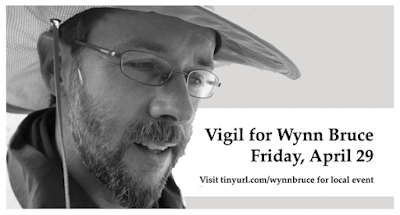
*** I want to add a note about Wynne Bruce, an American climate activist who set himself on fire in the plaza of the US Supreme Court Building in Washington, DC on Earth Day, 22 April 22. The fatal self-immolation was characterized by Bruce's friends and his father as a protest against the climate crisis. My heart goes out to those who lost such a deeply caring loved one. I cannot fathom the courage that his act of protest took.


13 January 2019

There Are So Many Things We Can Be Doing!

I think I'm just going to make a list today. I haven't offered this sort of thing in a long time, but we attended a meeting the other night where lots of ideas for what a nearby city (and the capital city of my province in Canada) can do about the climate crisis. I'll add in some of my own ideas.

Change now, as philosopher Krishnamurti taught. Picture … dream … envision how the world needs to be: free of war, terrorism, violence, cruelty and slaughter. A world free of fossil fuels, a “golden age” of zero-carbon renewable energy, will be safer, cleaner, kinder, healthier, more equitable, and more peaceful. It’s a beautiful vision, isn’t it?

For the sake of the children – of all species – find the strength, the courage and the compassion to truly feel the pain of the climate crisis. Next, lament. And then, get active. Remember that the most vulnerable are being impacted worst and first, but we are all impacted. People around the world are losing their lives or their loved ones, their livelihoods, their food security and water sources, their homes and entire homelands, in extreme weather events caused or exacerbated by climate chaos. We also need to understand this from the perspective of indigenous people, who have nowhere to move to because they are their land.

If you and your family are not already eating a plant-based diet, go vegan now, for the sake of your own health and the health of the planet. It’s the quickest – and most significant – way to lower your greenhouse gas emissions. Further, how can we create peaceful transformation in a world filled with slaughter and cruelty?

The Burning Age is over. Support a carbon fee and any other strategy that will encourage people to switch their investment money to zero-carbon, non-combustion renewable energy. Work towards a combustion-free society by transitioning away from the internal combustion engine.

Call for your government to keep its pledge to end taxpayer subsidies to fossil fuel industries. According to the International Monetary Fund, every year governments around the world give $5.3 trillion in direct and indirect subsidies to fossil fuel corporations. Just think how much faster we’ll make the transition to zero-carbon, non-combustion energy when all that money is switched to renewables.

Make a plan for reducing your family’s carbon footprint as rapidly as possible. Invest in the future by ensuring that your investments are ethical and green. Divest from fossil fuels. Vote with your dollars. Invest in a heat pump for your home to lower your heating bill. If you need to drive, save up to purchase a hybrid or electric vehicle. Figure how far you and your family are willing to walk, bicycle, take public transit, car share, etc., and set up systems to help you use these greener modes of transportation more often. Be willing to make changes, compromises, even sacrifices for the sake of the future.

Support fair elections and electoral reform so that governments are made up of elected officials representing all voices, not just those beholden to fossil fuel industries.

Learn the basic science of the unprecedented crime of greenhouse gas pollution and the anthropogenic (human-caused) climate and oceans crisis it has led to. Then learn why climate disruption and the trifecta of ocean heating, ocean acidification, and ocean de-oxygenation represent an urgent emergency. Understand that the climate change denial campaign is deliberate and extremely well funded. They can sound convincing, but don’t be fooled. Do your own research, check your sources, and stay strong.

The greatest immediate threat is food and water insecurity. After all, we have evolved over the last 10,000 years into a species dependent on agriculture – and agriculture is dependent upon a stable climate, which we’ve had globally for the last 10,000 years – until now. Encourage ecological and regenerative agricultural practices and the implementation of permaculture principles. Mulch your garden. Plant trees. Lend support (time, money, energy, expertise) to food-growing programs for children and schools. We can’t grow food overnight; nor can we learn to grow food overnight. Be a champion for a different kind of education … one that will help create the world we need.

Permaculture the heck out of your community. Turn public spaces and boulevards into food forests. Build food security, food sovereignty, food resilience. (If climate chaos is going to lead to worldwide hunger, at least we'll be among the last to go.)

Get your local municipal government/s to declare a climate change emergency. (The Climate Mobilization can offer guidance with this.)

Protest outside of any bank that is investing in global destruction. Divest while you're at it, and put your money into a community bank or credit union.

Pull off some "intersactions." Take your protest signs to the busiest intersection in your community and keep crossing the road when the walk sign is on walking around in a square. Get it? High visibility. Not illegal. Drivers won't be turned off because you're not blocking traffic.

Remember to make your planning meetings and your public actions inclusive (invite others who might not normally participate) and accessible (for example, to people with disabilities, to parents with small children). 

Finally, do your spiritual work – pray, meditate, dance, go for walks, whatever – but don’t stop there! Remember, we all have at least a little bit of time, money, energy and/or expertise to share.

 And hey, if none of these actions feels right to you, you can always bake muffins for those on the front lines of saving the world. Even protestors have to eat!

Adapted from Henry Van Dyke


14 October 2018

All Sorts of Reactions to the IPCC 1.5ºC Report — Except the Right One

If I don't talk this week about last Sunday's release of the Intergovernmental Panel on Climate Change (IPCC) Global Warming of 1.5ºC Report, I could possibly be the only armchair pundit who doesn't. So I will, but only to let you know my thoughts and feelings about the reaction to the report.

Although I live in the bubble of environmental non-governmental organizations (ENGOs) and enviro activists, it was impossible not to hear President T**** admit that he hadn't looked at it. "It was given to me. And I want to look at who drew it. You know, which group drew it. I can give you reports that are fabulous and I can give you reports that aren't so good," he said. I wonder where he gets his "fabulous" reports from. 

(This report was prepared by over 90 scientists from 40 countries who synthesized over 6,000 scientific references. It was then approved by all the governments in the world, although I heard from someone who was there that the US and Saudi Arabia and a handful of other countries threw up lots of roadblocks to that approval.)

Unlike their president, Republican politicians in the United States did have opinions — fatuous though they were. As reported by the Huffington Post, Sen. Roger Wicker (R-Miss.) said, "They might as well be calling on me to sprout wings and fly to Canada for the summer," and Sen. John Kennedy (R-La.) said of the actions urged by the report: "It's totally unrealistic. They must have parachuted in from another planet. There's not enough money in the world to pay for that. That's the problem with the UN that they come up with these policy ideas that are just 'La La Land.'" 

And yet President T**** is bragging these days (at the La La Land UN) that he just upped the US military budget to over $700 billion, an increase of 10%. So there's money enough for threatening, invading, killing, maiming, and destroying, but not for safeguarding life. Funny that.

Oh, and let's not forget the $5.3 trillion (TRILLION!) in direct and indirect subsidies that we taxpayers give to fossil fuel corporations every year. So there's money enough for coal, oil, gas, pollution, but not for the renewable energy technologies that could safeguard life. Funny that.

But I found the hardest part of this week were the responses of ordinary people like you and me who understand the climate crisis, who care about the climate crisis, who would perhaps call themselves climate change activists, but who are taking this report as a signal to stand down. I can't believe how many are giving up. Guy McPherson is in vogue again with his abrupt climate change "It's too late" message, so "live, love, and aim for excellence" (as one online commenter suggested to me). (By the way, there's nothing "abrupt" about this. We've known about it since at least the 1800s.)

Well, NO, damn it! I'm not giving up or giving in. I don't want to live excellently; I want my niece and all the beloved kids in my life to live, period. If we're going down, I want to go down swinging. I am going to carry on believing in the possibility of miracles through imagination and creative problem solving. I'm going to keep believing in the power of love and compassion to show our leaders that their own offspring will be impacted. I'm going to keep trying to teach ecological literacy and connecting with the rest of Nature. I'm going to keep seeing the potential for a return to simpler ways and a huge global race to zero carbon. Until my last breath. 

I believe that's the right reaction to the IPCC's 1.5ºC Report. For the sake of all the children, of all species, for all time.

p.s. I liked this article: Do we need an IPCC special report for humans?


21 May 2017

Cassandras of the World, Unite and Be Heard!

I was never much interested in Greek mythology and didn't study it in school. In fact, I knew nothing about Cassandra until people starting calling me by that name. Suddenly Cassandra became a theme in my writings about climate change.

Today I want to say that it feels like the Cassandras of the world are starting to be heard — and believed. Which means, of course, that the deniers and Big Money and Big Oil are becoming more and more desperate and underhanded. But it also means that the Cassandras of the world aren't as lonely.

My husband stumbled upon this prescient ABBA song yesterday (video below). It's from 1982 and was the B-side (only oldsters will understand that reference!) to their song The Day Before You Came. "Pity, Cassandra, that no one believed you ... Some of us wanted but none of us would listen to words of warning."

To be clear, I'm not saying that I have Cassandra's gift (or curse) of prescience or clairvoyance. I merely make and take the time to keep up to date on the climate change science and then look around the world to see what's already happening. And I understand that what's befalling others will soon enough befall us. Then I make and take the time to write and teach about what I've learned. That's when I get called Cassandra.

Alas, there are more and more of us, and our collective voice is getting louder and louder. (It also helps that people are witnessing economic signs that the market is moving to renewable energy, even if our governments aren't switching fossil fuel subsidies over yet, which is deplorable and unforgivable.)

Enjoy this blast from the past, even if the message is a sad one. And hey, invite a Cassandra out for a tea or coffee this week!


Cassandra
(written by Benny Andersson and Björn Ulvaeus; sung by Anni-Frid (Frida) Lyngstad and Agnetha Fältskog)

Down in the street they're all singing and shouting
Staying alive though the city is dead
Hiding their shame behind hollow laughter

While you are crying alone on your bed

Pity, Cassandra, that no one believed you
But then again you were lost from the start
Now we must suffer and sell our secrets
Bargain, playing smart, aching in our hearts

Sorry, Cassandra, I misunderstood

Now the last day is dawning
Some of us wanted but none of us would

Listen to words of warning
But on the darkest of nights

Nobody knew how to fight
And we were caught in our sleep

Sorry, Cassandra, I didn't believe

You really had the power
I only saw it as dreams you would weave
Until the final hour

So in the morning your ship will be sailing
Now that your father and sister are gone

There is no reason for you to linger
You're grieving deeply but still moving on
You know the future is casting a shadow
No one else sees it, but you know your fate
Packing your bags, being slow and thorough
Knowing, though you're late, that ship is sure to wait

Sorry, Cassandra, I misunderstood 

Now the last day is dawning
Some of us wanted but none of us would

Listen to words of warning
But on the darkest of nights
Nobody knew how to fight
And we were caught in our sleep
Sorry, Cassandra, I didn't believe you really had the power
I only saw it as dreams you would weave
Until the final hour

I watched her ship leaving harbor at sunrise,

Sails almost slack in the cool morning rain
She stood on deck, just a tiny figure
Rigid and restrained, blue eyes filled with pain

Sorry, Cassandra, I misunderstood

Now the last day is dawning
Some of us wanted but none of us would

Listen to words of warning
But on the darkest of nights
Nobody knew how to fight
And we were caught in our sleep
Sorry, Cassandra, I didn't believe you really had the power
I only saw it as dreams you would weave
Until the final hour

(I'm sorry, Cassandra)

02 April 2017

I Have a Question for Climate Change Deniers: What Is It Going to Take?

It was a bad week for those who believe that the children (of all species) deserve a future — one with a viable biosphere and a survivable climate.

First, "President" T**** (I refuse to give his name airtime) decided to halt American momentum on the climate crisis. Is that ignorance? Stupidity? Negligence? Or just plain cronyism? (With his biggest crony being Putin, who cares not for the Russian people but for the Russian gas and oil industries and their continuing profits.)

Then we got word that the climate change denial group, the Heartland Institute, is sending their denialist drivel of a book (authored by three fossil fuel industry shills with PhDs), intended to seed even more doubt about anthropogenic global warming in the minds of the scientifically illiterate American public, to 200,000 science teachers throughout the United States. Good grief — no, bad grief. 

As I commented online about a Washington Post piece about this travesty of propaganda, there is a bright side. The Heartland Institute has just set the precedent that will allow us to send a copy of Al Gore's new movie, An Inconvenient Sequel: Truth to Power, to 200,000 science teachers, too! After all, fair's fair. Thanks, Heartland.


An Inconvenient Sequel: Truth to Power trailer

I got up the nerve to ask Heartland Institute to explain their mindset given the climate change emergency we're facing down. Another commenter wrote: "You do know of course that in a matter of time, very distant time, the sun is going to burn up and that will bring about the end of life on earth as we know it. Our piddling carbon footprint in the grand scheme of things means very little."

My response? "So in the near future, you don't care what kind of world we're leaving the children? Because the sun's going to burn out in a few billion years?" (I was glad to see that others suggested her comment was inane if not a little hard-hearted.)

I am really trying to understand a mindset that seems to put profit and greed ahead of life. I feel like I'm missing something. We can't drink oil, breathe "natural" (methane) gas, or eat coal. So why do so many North Americans continue to defend those industries ... at our peril?

To another Heartland supporter and climate change denier who likes the idea of spewing pseudo-science to teachers across the United States, I suggested that they follow the money. "If you do your due diligence, you'll soon discover innumerable links between the authors, fossil fuel and (for at least two of the three) tobacco companies, and 'think tanks' or other organizations (such as Heartland) funded in part by Big Oil or Big Coal (Exxon, Koch Brothers, Peabody, etc.). Even the person who wrote the forward for this second edition works for a lobby group 'funded by New Mexico oil and gas industry interests' (Sourcewatch). What the authors Bob Carter, Fred Singer and Craig Idso do (and continue to do with this publication) is called shilling."

The Heartland Institute Facebook page has a Ronald Reagan meme up top: "Government's first duty is to protect the people, not run their lives." Then why, I asked, isn't the American government protecting its most vulnerable citizens (its children) from the hellish future that is already being unleashed by climate chaos? I just don't get it.

On a friend's FB page, in a discussion of T****'s climate change policy devastation (and the suggestion that he's doing this for the profit), someone wrote: "Exactly gore has made what a billion off of climate change." [sic]

I flipped on the guy. I'm so sick and tired of people ranging on Al Gore. I wrote: "The man has probably done more to make us aware of the climate change emergency than any other living human being. Gore understands that the fastest way to curb greenhouse gas emissions is through market mechanisms, which can turn on a dime (which T****'s stupid tweets have proven). I don't agree with him on everything (I don't agree with anyone on everything!), but revolution takes a lot longer than people think -- and we don't have that time." I invited him to read The Planet-Saving, Capitalism-Subverting, Surprisingly Lucrative Investment Secrets of Al Gore.


But I couldn't stop there: "If you want to rang on someone/something, why not rang on the governments (i.e., taxpayers) the world over who are still giving trillions of dollars in direct and indirect subsidies to fossil fuel corporations every year! (And that's while they say that renewable energy companies should be able to stand on their own two feet. Gimme a break. Fossil fuel corporations have never stood on their own two feet. Society has always had to pay the social/health and environmental costs of fossil fuel pollution.)"

Another one that made my blood boil said that abnormally high snowpack in the Sierras proved that climate change is a scam and the California drought is over. Look, we all hope and pray for California that their drought will end (heck, Canada gets nearly 50% of its food from that American state, so you know we've got our fingers crossed for good luck), but it's not as simple as one horrendously rainy season (five deaths!) and a high snowpack. All those aquifers and reservoirs and wells are going to take years to refill.

What is it going to take for climate change deniers to see that their delay tactics are endangering us all? Oh well, let's face it. It's just been a bad and sad week for the climate.


05 June 2016

Let's Start Picturing How We're Going to Stand Up to Globalized Capitalism

Stephanie McMillan
While visiting a friend's place last week, I picked up a copy of New Yorker Magazine that was lying on the end table in his living room. I flipped to an article about Jeremy Corbyn, Britain's new Labour Party leader, and read this: "It is easier for people to imagine the end of the earth [Earth?] than it is to imagine the end of capitalism." 

I nearly gasped out loud. I'd heard before that Canadians "would rather die comfortable than live uncomfortable" (see this post), but this was the first time it had been pointed out to me so starkly that those made comfortable by capitalism are NOT going to bite the hand that feeds them, even if that hand is killing off their children's future.

The quote was attributed to Fredric Jameson, an American literary critic and Marxist political theorist, best known for his analysis of contemporary cultural trends. What he actually said was:
"Someone once said that it is easier to imagine the end of the world than to imagine the end of capitalism. We can now revise that and witness the attempt to imagine capitalism by way of imagining the end of the world." 
Jameson makes a good point. Capitalism and "the end of the world" are rapidly becoming synonymous -- even if most EuroAmericans (and those we've globalized) can't picture any other economic system and therefore are willingly accepting the end of the world. (I call that a failure of imagination.) 

That "someone" that Jameson mentioned was Slavoj Žižek, a Slovenian sociologist, philosopher and cultural critic. And here is his exact quote:
"Think about the strangeness of today's situation. Thirty, forty years ago, we were still debating about what the future will be: communist, fascist, capitalist, whatever. Today, nobody even debates these issues. We all silently accept global capitalism is here to stay. On the other hand, we are obsessed with cosmic catastrophes: the whole life on earth [Earth?] disintegrating, because of some virus, because of an asteroid hitting the earth, and so on [um, climate chaos?]. So the paradox is, that it's much easier to imagine the end of all life on earth than a much more modest radical change in capitalism." 
— from Zizek!, a 2005 American/Canadian documentary film by Astra Taylor 
It's true, isn't it? Capitalism (of the globalized sort) has become the metaphorical water we swim in -- so we can't see it for what it is ... unkind, unfair, exploitive, lying, inequitable, dangerous, dirty, carbon intensive and greenhouse-gas-spewing. We've created quite the mess, haven't we? It's led to what my hubby calls a "widespread de facto conspiracy to keep supporting the fossil fuel industry and its tacit support by the majority of governments, scientists and and NGOs."

According to Žižek, it's possible that all we need is a "modest radical change in capitalism." I like that: "a modest radical change" ... but a radical change nonetheless. 

I've written before that we don't have time to effect that radical change BEFORE we save the world, but many of the solutions do entail a tweaking of our capitalist system (see this post). As Naomi Klein explains in This Changes Everything: Capitalism vs. The Climate:
"We have been told it's impossible to get off fossil fuels when in fact we know exactly how to do it -- it just requires breaking every rule in the 'free market' playbook: reining in corporate power, rebuilding local economies and reclaiming our democracies."
"Free market" in quotation marks? Yes, that's because it's not a free market. We're actually subsidizing fossil fuel corporations with direct and indirect subsidies in the trillions of dollars per year. With our tax dollars. Which also pay for all the externalized costs of fossil fuel burning. So it sure ain't a free market for us!

Reining in corporate power? Yes, how about a change to the corporate charter? Making it law that corporations must internalize all their health and environmental costs before counting their profits and paying dividends to their shareholders?
 

Rebuilding local economies? Yes, after we've got solar fusion technology down pat, scaleable to small communities and building the renewable energy infrastructure. (We need energy-dense power to transition to renewable energy -- but we can't be using coal and other fossil fuels to meet that goal.)
 

Reclaiming our democracies? Yes, people don't realize just how many democracies (and those we have elected to represent us in our governments) are "owned" by Big Banks and the fossil fuel industries. (Here in Canada, we elected a party whose national campaign co-chair, who has since resigned, gave lobbying advice to a major Canadian pipeline company less than a week before the election. See what I mean?)

How about if we start clearly picturing how capitalism is ending life on Earth -- and then start imagining how we're going to stand up for the children and end the destruction?

I love this one! Ah, dear sweet Capitalism,
it was fine until you got greedy!


22 June 2014

Launching the Climate EMERGENCY Countdown

Well, today's the day of our Climate Emergency Countdown conference in Toronto. But you, dear reader, are getting the scoop right here.

We figure we have until December 2015 to safeguard the future. Here's what we're picturing:


5         TELL THE WHOLE WORLD
Start now. Encourage all ENGOs (as well as human rights, development, and public health NGOs) to mount a massive education / agitation campaign. Educate about RCP2.6 and CAN International’s position statement (see below). Help everyone in the world understand the climate emergency and that there are simple yet powerful solutions (see below). And then encourage everyone to apply pressure to their own governments. Get everyone calling for an emergency zero-carbon global agreement in Paris (see below).

4         IN NEW YORK, DEMAND THAT GOVERNMENTS DECLARE THE CLIMATE CHANGE EMERGENCY
New York is the place to be this September. In every way possible, let's urge attendees at the NYC September 20-21, 2014 People's Climate March to call for a DECLARATION that CLIMATE CHANGE is an EMERGENCY. And in every way we can think of, let's urge all government representatives and negotiators at UN Secretary-General Ban Ki-moon's Climate Summit 2014: Catalyzing Action to declare the emergency.

Once governments declare that we are “beyond dangerous anthropogenic interference with the climate system” (UN Framework Convention on Climate Change), things will start to happen. This declaration would be an automatic trigger for the bureaucrats who work underneath politicians and within governments to start working on climate change solutions. Scientists say that determining whether climate change is an emergency is a value judgement that society must make. So let's make it! We're society. Let's get the CLIMATE EMERGENCY DECLARED! 

3         FOR THE LIMA CLIMATE CHANGE CONFERENCE (COP20 in December 2014), DEMAND THAT NEGOTIATORS ADOPT THE IPCC's RCP2.6 SCENARIO + the CAN INTERNATIONAL POSITION STATEMENT
The essential text of the all-important 2015 Paris agreement will be determined in Lima, Peru this year. The best-case IPCC scenario (which is all that government negotiators can work with), one that can possibly keep us below a catastrophic 2ºC rise in global temperatures, is called RCP2.6. (RCP stands for Representative Carbon Pathway, but I think it really means REALLY COOL PLAN!) Let's start calling now for adoption of RCP2.6 PLUS these important new Climate Action Network (CAN) International positions:
•sharp declines in GHG emissions starting 2015 (RCP2.6 has emissions starting to decline in 2020, but really, folks, we're already out of time)  
•reaching zero carbon emissions by 2050, specifically by transformation of all fossil fuel energy to clean renewable energy (RCP2.6 does not go far enough to save our butts)
•limit warming to 1.5ºC (not the deadly 2ºC "target") 
2         CALL FOR THE END OF FOSSIL FUEL SUBSIDIES AND PUT A PRICE ON CARBON (by the December 2015 COP21 in Paris)
Governments "give" $1.9 trillion every year in direct and indirect subsidies to fossil fuel corporations. Direct subsidies must be switched to perpetual energy technologies. Period. Especially in developing nations to help them "leapfrog" over fossil fuel dependence. We also need to demand an economic shift that will make fossil fuel companies pay for their $1.4 trillion every year in economic externalities (indirect subsidies or "mispricing"). 

We need to charge a FEE on CARBON EMISSIONS to pay for their health and environmental costs and to help offset the transition to the Solar Age. This "price" on carbon can be applied to promoting the use of safer, cleaner, healthier, more equitable and more peaceful perpetual energy technologies ("perpetual" means renewable without biomass burning technologies, since burning emits carbon). This carbon fee will signal the market overnight, and investments will be switched to renewables.

1         IN PARIS, GET THE MOST IMPORTANT AGREEMENT IN THE WORLD SIGNED
“Though a great many obstacles remain in the path of this essential agreement, I am among the growing number of people who are allowing themselves to become more optimistic than ever that a bold and comprehensive pact may well emerge from the Paris negotiations late next year, which many regard as the last chance to avoid civilizational catastrophe while there is still time.”          — Al Gore 
0         ACHIEVE ZERO CARBON by 2050
Post Paris, we need to immediately begin a rapid decline in greenhouse gas emissions. And then we need to continue that decline for decades, until we reach zero carbon emissions by 2050 … and safeguard the future.


30 March 2014

No to Climate Change, But No Time for System Change

We attended a lecture (we had to leave early, so missed the "public forum" part) the other night by Professor Richard Smith, Rutgers University lecturer, economic historian, member of the System Change Not Climate Change network in the U.S. and author of articles like "Green Capitalism: The God That Failed" and "Capitalism and the Destruction of Life on Earth: Six Theses on Saving the Humans."

Professor Smith's visit was sponsored by the Social Environmental Alliance and the Vancouver Eco-Socialist Group, organizations that see capitalism as a root cause of the climate change crisis and who are calling for "system change" as the crisis deepens.
"Ecosocialists see this ecological crisis as a symptom of the underlying economic and social system called capitalism, whose basic operating features include: (1) the imperative of profit and competition-driven expansion without limit, (2) the treatment of human labour and the natural world as commodities for sale rather than having value for human well-being and ecological stability; (3) benefits to a small and privileged social class wielding inordinate political power, (4) deformed social priorities amongst humans, including in our relationship to the rest of nature."
The title of Smith's talk was No to Climate Change - Yes to System Change. It was interesting and in many ways, spot on. He sure understands the climate change emergency. He is calling for a revolution away from capitalism -- or at least the worst forms of our Western, industrial, globalized, capitalist economy (the pillaging sort of capitalism that doesn't give a damn about the consequences of habitat destruction, resource loss, pollution or climate change). 

The problem is, we don't have time for an economic revolution. We need to get going on what we can be doing now. And that's simple. Economists keep telling us that the market can solve our ills. The time has come for them to prove it. Let's see what that "invisible hand" does with the market once we've set the following in place. My guess is that investments will swing briskly toward renewables!

1. Stop all direct and indirect subsidies for fossil fuels.**

2. Tax carbon. Really tax carbon.

3. Charge for pollution. Let companies pay for the social (health) and environmental costs of their businesses, damn it. Seriously, why should taxpayers have to cough up when corporations should be paying these costs before calculating their profits and paying dividends to shareholders?

4. And what of the banks? Don't they have just a teeny weeny bit too much power ("credit capitalism")? With none of the responsibilities?


** Some people worry that removing all fossil fuel subsidies will be unjust for poorer people. In the short term, this could well be true. But long term, fossil fuels are going to kill all of us, whether we're rich or poor. However -- and I welcome your thoughts on this, as mine aren't fully formed yet -- I think that winning an international race to zero carbon will actually be easier for the least developed nations, as they have come late to the fossil fuel party. Climate justice is for future generations as much as for today's less fortunate.

09 October 2011

A Global Suicide Prevention Strategy

Canada's House of Commons agreed this week (something its members don't often do) to create a National Suicide Prevention Strategy. The vote was practically unanimous, I've heard. Everyone agrees that suicide is tragic and heartbreaking. Media pundits believe, however, that talk is cheap and that talking about developing a strategy to prevent suicide is not the same as taking action to prevent suicide.

I am very lucky that my life has only ever been peripherally touched by suicide. My heart goes out to anyone who has ever felt suicidal or been devastated by the suicide of a loved one. I know it leaves nothing but a trail of tears and questions behind. (Was there more I could have done? Something I could have done differently? Some clue I should have picked up on?) I know its causes are innumerable — from mental health issues (such as depression), to socioeconomic despair (suicides are rising amongst farmers around the world), to not taking seriously the immense pain felt by a young person whose first boyfriend or girlfriend has broken up with them. (It's not just "puppy love" to them.)

All of this got me thinking about suicide in broader terms, and I wondered (due to our parliament's unanimity) if the idea of global suicide prevention is something people could easily grasp and get behind.

The English word "suicide" comes from the Latin sui "of oneself" + caedere "kill." And it is true that we are killing ourselves — certainly our species, our progeny (hence, my coined term "progenycide"), if not our own children or grandchildren.

As with personal suicide, there are still many who can't, won't or just don't see the danger signs. There are still many who deny the insanity of our system, which is based on infinite growth on a planet of finite resources. There are still many who are ecologically (and historically) illiterate and don't understand the connection between civilization, agriculture/food security, and a stable climate. There are still many who pooh-pooh the seriousness of the climate change emergency, a risk I've never fathomed. (Think how those people can gloat if those raising the alarm are wrong. Think of the perilousness of their stance if they themselves are wrong.)

So what would a global suicide prevention strategy look like? Here are my ideas. Please feel free to add your own.
  1. Declare the planetary climate change emergency.
  2. Immediately stop all subsidies to fossil fuel industries. (They are doing quite well on their own, thank you, and we should not be continuing to feed the AGW* beast.)
  3. Immediately switch all subsidies to promote the growth of renewable energy technologies and businesses.
  4. Immediately make it law that all businesses must pay for their hitherto externalized social and environmental costs.
  5. Immediately tax carbon. (Create an international even playing field.)
  6. Immediately create a Global Green Fund with a donation from every nation of 10% of its military budget.
  7. Plant trees. Plant trees. Plant trees. Plant trees. Everywhere, everyone, at every level of government.
  8. Teach children how to grow food. NOW.
  9. Put the children and all future generations of our species at the centre of all our talks, conferences, summits, and negotiations.
  10. Do everything in our power to refreeze the summer Arctic sea ice. (Prepare to paint every black roof and dark surface in the world white, which will create reflective, cooling albedo.)
  11. Create a Global Suicide Prevention support group. This stuff is scary and we need friends and like-hearted community members to help us face all this and work at it. Most of the actions above are not things that individuals will do, but together we can be change the political will of our governments.

* AGW = anthropogenic (human-caused) global warming