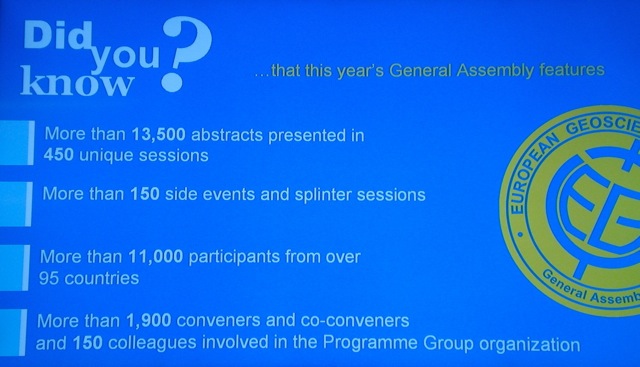
We (my husband and I) have spent the week at a huge geophysical science conference — thousands upon thousands of scientists who study the non-living aspects of the Earth converged in one place — and only one showed up for a special session to determine whether we have enough evidence to declare that we're in a state of climate change planetary emergency.
Why is that? In Tuesday's conference newsletter, the conference communications officer said, "The life of a scientist is not an easy one. In addition to pushing the boundaries of our knowledge, scientists have the added pressures of applying for grants, enhancing public understanding, teaching, publishing, data-crunching and generally saving the world as they multi-task to the extreme!"
I'm curious about what part of "generally saving the world" equals ignoring the emergency signs (or being unwilling to talk about them) when a bit of synthesis shows so clearly that they exist.
Is it because scientists believe that only governments, or the people they, ahem, represent, can use terms like "dangerous" and "emergency"? That's what the Intergovernmental Panel on Climate Change keeps insisting, saying that it's a value judgement.
In this case, is it because these are not life scientists? That doesn't automatically make them non-life (or worse, anti-life / life-as-nuisance) scientists, does it?
Is it because scientists aren't confident learning or talking about social issues (and they see the global transformation we have to make as primarily a human/social development issue?), the way non-scientists often aren't comfortable in scientific discussions?
Perhaps it's due to the reductionism that keeps constricting ever tighter the higher up the science education ladder you go. Take a look at your average elementary school science curriculum. It includes processes of science, life science, physical science, and Earth and space science. But once you're doing your PhD in "morphodynamics of particulate geophysical flow" or "Earth's inner magnetosphere coupling," you've left a lot of your biology — the study of life — behind.
Is it that we've placed too much confidence in our scientists — and too much responsibility upon them?
This whole thing helped me see that our salvation does not lie with scientists, who have to research, apply for grants, enhance public understanding, teach, publish, and crunch data before they'll ever get around to saving the world. I am no longer in awe. They are simply busy human beings, like the rest of us.
Scientists do not have a monopoly on world saving, that's for sure. Not that I want to let them off the hook entirely, either. We're all in this together.
p.s. I want to apologize to anyone who has left a legitimate comment recently. I tried "deregulating" who can make a comment and how, but ended up with dozens of spam messages practically overnight. (Spammers, give just a fraction of that time to the climate change fight!) In trying to get rid of the spam, I got rid of several wonderful comments, too. I'm very, very sorry about that, as I have no way of retrieving them. (Ah, the tyranny of the "enter" key.)