Showing posts with label reductionism. Show all posts

01 September 2013

"The Death Orientation that Stares at Us from Our Plates"


I'm going to be attending and emceeing a presentation tonight by Dr. Will Tuttle on his bestselling book, The World Peace Diet: Eating for Spiritual Health and Social HarmonyI think what I'm really looking forward to is a sort of "darshan"— being in the presence of one who is enlightened. Never has a book taken me on such a voyage of discovery and on such a roller coaster ride of emotions! This former Zen Buddhist monk has articulately synthesized ideas I've been wondering about for years.

  • Why is there so much cruelty and violence in our human world?
  • Where does "man's inhumanity to man" — and to nonhuman animals — come from?
  • Why do we think we're so much better than other animals?
  • Why can people (in our society) love their pets so much but then slap a hunk of a lamb, a pig, a chicken or a steer on their plates and eat it without ever making (seeing, feeling) the connection?
  • Beyond the greenhouse gas toll of industrialized meat processing, what (and who) else suffers because of our meat-based diet?

Dr. Tuttle explains all that and more. I'm not going to tell you too much because I wouldn't do it justice and I want you to buy (or borrow) the book and read it. Really take it in. And, every chapter or two, slam the book shut and sob and sob and sob at the unspeakable atrocities committed (at least in our society) so that people can have their hunk of flesh and eat it too.

But let me leave you with a couple of "big ideas" from Will Tuttle. 

The first is that the move to the herding of large mammals about 10,000 years ago was the start of it all, including the beginnings of raging capitalism (which is bringing not just the natural world but human civilization to its knees):
"In fact, our word 'capital' derives from capita, Latin for 'head,' as in head of cattle or sheep. The first capitalists were the herders who fought each other for land and capital and created the first kingdoms, complete with slavery, regular warfare, and power concentrated in the hands of a wealthy cattle-owning elite.... By commodifying and enslaving large, powerful animals, the ancient progenitors of Western culture established a basic mythos and worldview that still lives today at the heart of our culture." (pp. 18-19)
The second point is something that is making people laugh when I share it with them. And sometimes laughter creates a beeline to the heart and soul, so that people can really hear something their mind doesn't want to listen to. 

Hmmm, I just found the passage back on pp. 67-68 and it's rather graphic to quote here for you. Anyway, here's the gist: Lots of people think that we're "meant" to eat the flesh and secretions of other animals, that it's perfectly natural for us to eat meat and "dairy" products. So here's a question: Could you, using no implements, just your body (with your tiny mouth, dull teeth, delicate skin and no claws) hunt down a deer? Kill it with your teeth, rip it apart and eat it? 

Okay, here's another question: If we were meant to drink the milk designed for calves, then shouldn't we be able to walk past the bull, kick that calf out of the way, and then slide underneath the cow to suckle at her teat without getting kicked or stomped on?

For 30 years I was a vegetarian who considered cheese and eggs to be "gifts" from the animals. But gifts are freely given. Choosing a vegan diet three years ago (for environmental reasons, but also because all my talk of compassion was no longer squaring with my diet) has allowed me to truly see what's going on in this world. Otherwise, I would still be stuck in my own herder mentality. 

May the "spiritual health" and "social harmony" of Dr. Will Tuttle's book, The World Peace Diet, come true in time for compassion to save the future for the children ... of all species.

Is anyone else weirded out by the fact
that our culture eats
the children of other animals?

14 April 2013

Why Scientists are NOT Saving the World

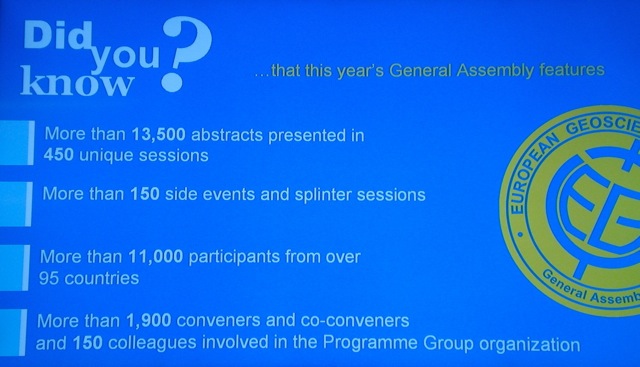
We (my husband and I) have spent the week at a huge geophysical science conference — thousands upon thousands of scientists who study the non-living aspects of the Earth converged in one place — and only one showed up for a special session to determine whether we have enough evidence to declare that we're in a state of climate change planetary emergency.

Why is that? In Tuesday's conference newsletter, the conference communications officer said, "The life of a scientist is not an easy one. In addition to pushing the boundaries of our knowledge, scientists have the added pressures of applying for grants, enhancing public understanding, teaching, publishing, data-crunching and generally saving the world as they multi-task to the extreme!"

I'm curious about what part of "generally saving the world" equals ignoring the emergency signs (or being unwilling to talk about them) when a bit of synthesis shows so clearly that they exist.

Is it because scientists believe that only governments, or the people they, ahem, represent, can use terms like "dangerous" and "emergency"? That's what the Intergovernmental Panel on Climate Change keeps insisting, saying that it's a value judgement.

In this case, is it because these are not life scientists? That doesn't automatically make them non-life (or worse, anti-life / life-as-nuisance) scientists, does it?

Is it because scientists aren't confident learning or talking about social issues (and they see the global transformation we have to make as primarily a human/social development issue?), the way non-scientists often aren't comfortable in scientific discussions?

Perhaps it's due to the reductionism that keeps constricting ever tighter the higher up the science education ladder you go. Take a look at your average elementary school science curriculum. It includes processes of science, life science, physical science, and Earth and space science. But once you're doing your PhD in "morphodynamics of particulate geophysical flow" or "Earth's inner magnetosphere coupling," you've left a lot of your biology — the study of life — behind.

Is it that we've placed too much confidence in our scientists — and too much responsibility upon them?

This whole thing helped me see that our salvation does not lie with scientists, who have to research, apply for grants, enhance public understanding, teach, publish, and crunch data before they'll ever get around to saving the world. I am no longer in awe. They are simply busy human beings, like the rest of us. 

Scientists do not have a monopoly on world saving, that's for sure. Not that I want to let them off the hook entirely, either. We're all in this together.

p.s. I want to apologize to anyone who has left a legitimate comment recently. I tried "deregulating" who can make a comment and how, but ended up with dozens of spam messages practically overnight. (Spammers, give just a fraction of that time to the climate change fight!) In trying to get rid of the spam, I got rid of several wonderful comments, too. I'm very, very sorry about that, as I have no way of retrieving them. (Ah, the tyranny of the "enter" key.)